
Cabinet restoration guide
Are Your Old Kitchen Cabinets Worth Saving? A Connecticut Homeowner’s Inspection Guide
A practical inspection guide to cabinet boxes, doors, drawers, and finishes—so you can understand what is worth keeping before planning your next project.
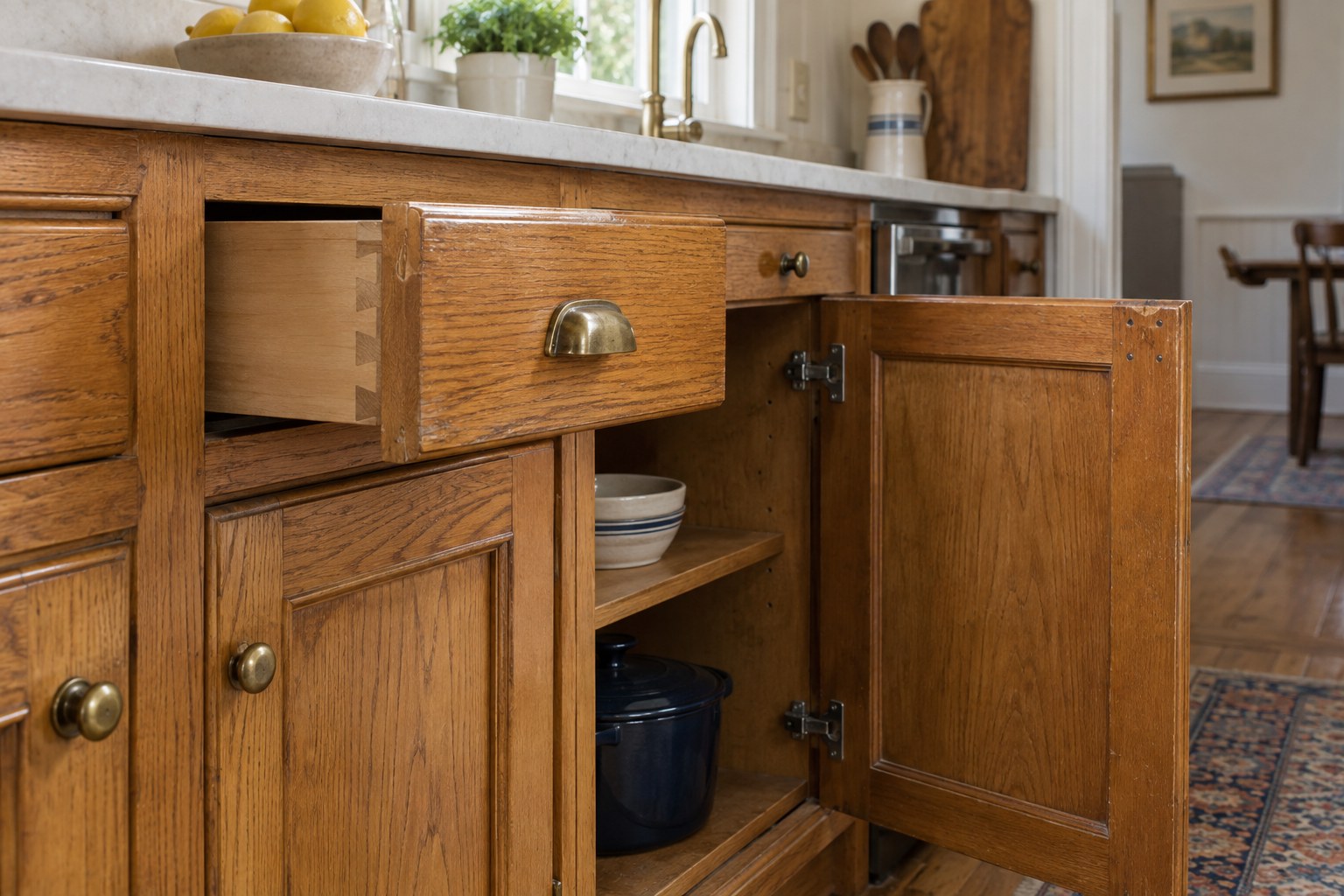
The cabinet door beside the sink looks rough. A drawer catches unless you lift it slightly. The finish around the trash pullout has worn away, and the whole kitchen feels older than the rest of your home.
It is tempting to look at those problems and assume everything needs to go.
Sometimes replacement is the right decision. But visible wear does not tell the whole story. Cabinets consist of several parts, and those parts do not necessarily wear out together. A tired finish can cover a sturdy structure. A frustrating drawer might need a hardware repair. A damaged door may be replaceable without removing the cabinet behind it.
Before deciding whether to restore your kitchen cabinets, separate appearance problems from structural problems.
A careful inspection can help you understand what you have, what needs attention, and which questions to ask a professional.
Why Cabinet Condition Matters More Than Age Alone
The year your cabinets were installed gives you background information. It does not provide a complete verdict.
Construction, installation, water exposure, past repairs, and daily use all influence condition. Older cabinets are not automatically better built, and newer cabinets are not automatically beyond repair.
Homeowners also renovate for different reasons. In the 2026 U.S. Houzz Kitchen Trends Study, 41% of surveyed renovating homeowners cited dissatisfaction with their kitchen’s old style, while 38% cited deterioration or dysfunction as a reason for renovating. Appearance and performance both matter, but they call for different assessments. 1: Houzz
A useful first step is making two lists.
On one, write everything you dislike about the way the cabinets look. On the other, record everything that does not work properly.
“Too dark” belongs on the first list. “Drawer falls off its track” belongs on the second. Keeping those observations separate makes the eventual conversation more productive.
1. Look Inside the Cabinet Boxes
The cabinet box is the structure behind the door. Its condition has a major influence on whether restoration makes sense.
Empty a few representative cabinets so you can see the bottoms, backs, corners, and shelf supports. Pay particular attention to areas near plumbing and appliances.
Look for:
- Swollen or crumbling material.
- Separated joints.
- Sagging shelves.
- Water staining.
- Loose backs or damaged corners.
- Signs that earlier repairs are failing.
Do not assume every stain means the structure is ruined. A past spill may leave discoloration without significant damage. Conversely, a surface that looks acceptable from the front can hide deterioration inside.
Take photographs of anything questionable. If a cabinet appears loose or insecure, stop using it for heavy storage and have the installation assessed. Do not pull on it to test its strength.
2. Give the Sink Base Extra Attention
The cabinet beneath the sink deserves its own inspection because small plumbing leaks can remain unnoticed behind cleaning supplies.
Remove the contents and look around supply connections, the drain area, the cabinet floor, and the lower edges.
A practical assessment needs to answer two questions: Is the moisture source resolved, and how much material has been affected?
Refinishing over an active leak does not solve the problem. Neither does covering a deteriorated cabinet bottom with a new surface.
Localized damage may allow a targeted repair. More extensive deterioration may call for replacement of that cabinet. The surrounding cabinetry still deserves an independent evaluation.
Before approving cosmetic work, make sure the proposal explains how any damaged areas will be handled and who is responsible for correcting the moisture source.
3. Separate Door Problems From Cabinet Problems
Doors take a lot of everyday abuse. People pull them with wet hands, bump them with chairs, and occasionally hang damp towels over them.
Look at each door’s shape, edges, joints, and finish.
A scratched finish is different from a warped door. A loose hinge is different from a damaged mounting area. A small chip presents a different repair challenge from a split that keeps opening.
Also consider whether you like the door design.
If the doors remain sound and their style suits your home, refinishing may be worth exploring. If the boxes are good but the door style is the main issue, refacing may be more appropriate.
Ask whether damaged components can be repaired or matched. Matching an existing profile, wood appearance, and finish can require more work than homeowners expect.
4. Open Every Drawer
A kitchen can look attractive and still be frustrating to use.
Open and close each drawer normally. Note sticking, sagging, rubbing, loose fronts, or movement that feels uneven. Check whether the problem changes when the drawer is empty.
The cause may involve slides, alignment, the drawer box, the cabinet opening, or several components together.
Industry testing offers a useful perspective on why hardware and construction deserve attention. The Kitchen Cabinet Manufacturers Association describes durability testing that includes 25,000 opening-and-closing cycles for doors and drawers. Those tests apply to cabinetry evaluated under its certification program; they do not establish a remaining lifespan for your existing cabinets or certify a refinishing job. 2: KCMA
For your kitchen, the practical question is simpler: Can the existing components be adjusted or repaired, and will an upgrade fit?
Do not assume that new handles or new drawer fronts will correct poor movement.
5. Identify What the Cabinets Are Made Of
A wood-looking surface is not necessarily solid wood.
A single cabinet installation may combine solid wood doors, veneered panels, engineered-wood boxes, and other materials. Each component needs to be considered on its own.
Material identification affects the available repair and finishing options. A thin veneer, for example, cannot be treated as if it were a thick piece of solid lumber. A peeling decorative covering presents a different problem from a worn clear finish.
You do not need to become a cabinetmaker before requesting an estimate. You do need a contractor who can explain what the surfaces are and why the proposed method is suitable.
Ask for that explanation in plain language. A recommendation should connect the material’s condition to the expected result.
6. Decide Whether the Layout Still Serves You
Cabinets can be repairable and still be wrong for the way you use the kitchen.
Think about an ordinary weekday. Where do you prepare food? Which items are hard to reach? Does an open dishwasher block the cabinets you need? Are everyday dishes stored in an inconvenient place?
Some problems may be improved with compatible accessories or selective modifications. Others require changes to cabinet dimensions or the arrangement of the room.
Be specific about priorities. “More storage” could mean room for sheet pans, a place for small appliances, or drawers that make heavy pots easier to reach.
A restoration proposal should address those needs honestly. A refreshed finish has value, but it should not be expected to solve a layout problem.
7. Ask for Evidence of the Proposed Result
Before choosing a contractor, ask to see examples of comparable work.
Look for projects involving similar cabinet materials, door designs, and starting conditions. A photograph of new custom cabinetry does not show how an older finish was restored.
Useful questions include:
- Which existing components would you keep?
- Which repairs are necessary before finishing?
- What surface texture should I expect?
- How will damaged edges or previous repairs look afterward?
- Can I see a representative finish sample?
- What does the written warranty cover?
A professional should be willing to discuss limitations. Some repairs remain more noticeable under stain than under an opaque finish. Some doors may cost more to restore than to replace.
Understanding those tradeoffs before the work starts is part of getting a result you will be happy with.
Caring for Restored Cabinets
Once cabinets have been restored, everyday habits influence how well their appearance holds up.
Follow the instructions for the actual finish installed in your kitchen. General care advice is useful, but it should not override product-specific guidance.
Cabinet manufacturer Canyon Creek recommends promptly removing spills, avoiding abrasive cleaners, keeping damp towels off doors, and directing appliance steam away from cabinet surfaces. Those are practical points to discuss when receiving your own care instructions. 3: Canyon Creek
Ask when cleaning can begin and which products are appropriate. Keep the finish information and warranty with your project paperwork so you do not have to guess later.
Frequently Asked Questions
Are 20- or 30-year-old kitchen cabinets worth refinishing?
They can be. Age alone does not determine suitability. The cabinet boxes, doors, installation, existing finish, and layout all matter. Sound cabinets that meet your needs may be worth preserving, while extensively damaged cabinets may justify replacement regardless of their age.
Does peeling paint mean the cabinets need replacement?
Not necessarily. Peeling may involve a coating problem rather than a failed cabinet structure. The cause needs investigation before another finish is applied. Ask how the existing coating will be evaluated and removed or prepared where necessary. A new layer should not be treated as a cure for underlying failure.
Can one damaged cabinet be replaced without replacing everything?
Sometimes. A targeted replacement depends on access, dimensions, countertop support, adjoining cabinets, and the ability to coordinate the appearance. Have the complete area evaluated before assuming the damaged unit can simply slide out. Selective repair or replacement should be planned as carefully as the visible finish work.
Can I add soft-close hardware to old cabinets?
An upgrade may be possible, but compatibility matters. Cabinet construction, door configuration, drawer dimensions, and mounting locations affect the options. Ask the contractor to inspect the existing hardware and specify what will be replaced. “Updated hardware” should clearly distinguish decorative handles from hinges and drawer slides.
Should I sand old painted cabinets before getting an estimate?
Leave existing painted surfaces undisturbed until they have been assessed, especially in an older home. EPA recommends using a lead-safe certified contractor for renovation work in pre-1978 housing. Discuss the age of the home and any known paint history before preparation begins. 4: EPA
How can I tell whether a restoration estimate is thorough?
Look for a description of the existing condition, necessary repairs, included surfaces, proposed finish, hardware work, protection, cleanup, and project schedule. The proposal should also explain exclusions. If an important issue came up during the inspection, make sure the written scope addresses it.
Find Out What Is Worth Keeping
You do not need to decide between saving everything and replacing everything before talking with a professional.
Start with the condition of the cabinets, then consider appearance, daily use, and budget. A thoughtful evaluation may point toward refinishing, refacing, targeted repairs, selective replacement, or a larger redesign.
Elite Valor Wood Works provides cabinet refinishing, refacing, and custom woodworking services in Northern Connecticut. Visit Elite Valor Wood Works to discuss your kitchen and the changes you have in mind.
A few clear photos and a list of the problems you want solved are a useful place to begin.
Sources
- Houzz — 2026 U.S. Houzz Kitchen Trends Study
- Kitchen Cabinet Manufacturers Association — ROI of Cabinet Durability: Reducing Project Risk With A161.1
- Canyon Creek Cabinet Company — Cabinet Care Guide
- U.S. Environmental Protection Agency — Lead Renovation, Repair and Painting Program
- Elite Valor Wood Works — Cabinet and Woodworking Services
Let’s talk about your cabinets.
Discuss your ideas with Elite Valor Wood Works in Northern Connecticut.
Request a Free Estimate